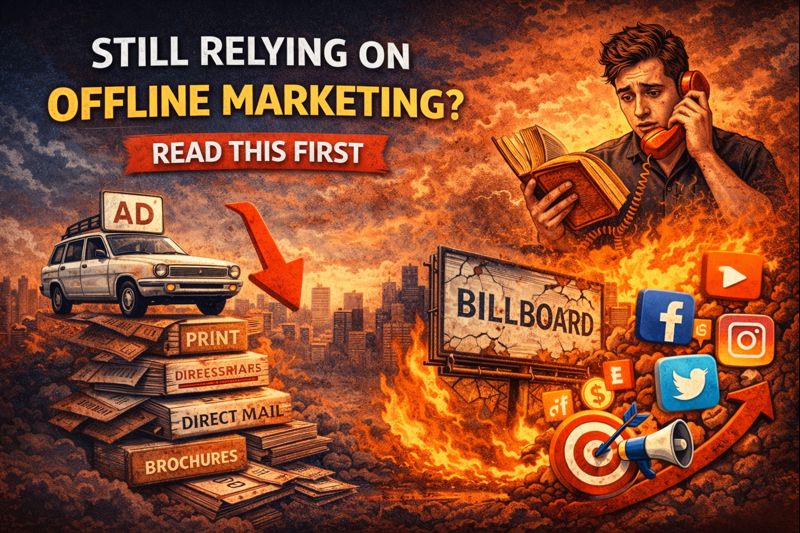
Introduction: The Comfort Zone That’s Costing You Growth
Pamphlets, newspaper ads, banners, and word-of-mouth once built successful businesses.
And they still feel safe.
But here’s the uncomfortable truth:
Your customers have moved online—and your marketing hasn’t.
If you’re still relying mainly on offline marketing, you may be visible to some people, but invisible to the right people at the right time.
Before you invest another rupee in traditional promotion, read this carefully.
Why Offline Marketing No Longer Delivers Predictable Results
Offline marketing isn’t useless—but it’s no longer enough.
Here’s why businesses struggle when they depend on it alone:
- Limited reach within a fixed area
- No clear way to track performance
- High recurring costs
- One-way communication
- Difficult to scale
Real-world example:
A local store prints 5,000 flyers but doesn’t know who reads them or who buys because of them.
The same store running a simple online campaign can track views, clicks, calls, and sales—in real time.
How Customer Behavior Has Changed
Modern customers don’t ask around first. They search.
Before buying, they:
- Google the business
- Read reviews
- Compare options
- Check social proof
If your brand doesn’t show up online, the decision is often made before you get a chance.
Offline marketing creates awareness.
Digital marketing creates intent-based discovery.
Step-by-Step: Transitioning From Offline to Smart Digital Marketing
Step 1: Build a Strong Online Presence
- A professional website
- Clear services and contact details
- Mobile-friendly design
Step 2: Get Found Where Customers Search
- Optimize for search engines
- Target keywords customers actually use
- Focus on local visibility if relevant
Step 3: Educate Instead of Just Promoting
- Publish helpful content
- Answer common customer questions
- Build trust before selling
Step 4: Track What Works
- Monitor website visits
- Measure leads and conversions
- Improve based on data, not guesswork
Step 5: Combine Online + Offline
- Use offline methods to support digital
- Direct people to your website or social platforms
- Create a connected experience
Common Mistakes Businesses Make
Many businesses fail in digital transition because they:
- Expect instant results
- Treat digital marketing like advertising only
- Post content without strategy
- Ignore analytics and insights
- Stop too early
Digital growth rewards patience and consistency.
Tips & Best Practices for Sustainable Marketing
- Think audience-first, not channel-first
- Use offline marketing to push people online
- Invest in long-term visibility, not short-term noise
- Focus on trust, clarity, and relevance
- Review and refine monthly
The goal isn’t to abandon offline marketing—it’s to upgrade your strategy.
FAQs
1. Is offline marketing completely outdated?
No. It still has value, but it’s far more effective when combined with digital channels.
2. Can small businesses afford digital marketing?
Yes. Digital marketing can start small and scale based on results, making it cost-effective.
3. How quickly can digital marketing replace offline results?
Some channels show results within weeks, while others build momentum over months.
4. Do local businesses really need to be online?
Absolutely. Local searches are one of the biggest drivers of real-world customers.
Conclusion: Don’t Market Where Customers No Longer Look
Offline marketing built yesterday’s businesses.
Digital marketing builds today’s and tomorrow’s brands.
If you want consistent leads, measurable growth, and long-term visibility, relying only on traditional methods is no longer safe.
👉 Start strengthening your digital presence now—before your competitors take the space you left open.